• Skip to main content
  • Skip to primary sidebar

Dawn Barclay

Helping you align all that you do with your core values

  • New? Start Here
  • Is This You?
    • You Want to Reclaim Your Courage & Confidence
    • You Want to Align Who You Are With What You ‘Do’ In the World
    • You Need More Moxie for Your Business
    • You Are Looking for Values Training for You or Your Team/Group
  • Work Together
    • Online Workshops & Training (All)
    • Live Events & Training Workshops (All)
    • Upcoming Events (List)
    • ValuesBase© Coaching
  • Blog
  • About
    • Living Moxie Mission & Values
    • Approach & Ethos
    • About Dawn
    • About You, The Moxieologist
    • Kind Words
    • Contact

Blog

Children, Confidence and Self Esteem

August 10 Dawn

As parents and carers is one of the hopes and wishes for your children that they grow up happy, with the confidence to ‘stand on their own two feet’ and high self-esteem? Ensuring they can cope and still remain strong with whatever to them in life.Children are incredibly resilient, determined, driven and amazingly creative, ah, at one time we all had these skills, they came with being young!

Yet, many parents can see their once confident child completely change before their eyes, she seems to be more fearful and perhaps withdraw from the activities and hobbies she once loved.

When Should You Consider Your Childs Self Esteem?

During pregnancy and as a new parent you may never consider the confidence and self-esteem of your new baby.  In fact, it may not even cross your mind at all unless you begin to notice the change of behaviour.

If you’re a new parent:

Spend time thinking (even if it’s just ten minutes every month) about your child’s confidence and self-esteem.  Picture as you watch them growing everyday what you wish and hope for in their life.

Everything she sees, hears, feels, tastes and touches will be stored and called upon as she grows, when she is making her own decisions and choices.  Actual events may not be remembered in years to come; yet her brain is hard at work registering and programming the world around her.

You see, as adults we can sometimes forget that all through those development years we are ‘conditioning’ and ‘moulding’ and ‘shaping’ her beliefs.

If you’re lacking in confidence and self esteem:

Many times I have worked with parents on courses and they have all said ‘I wish I had this course as a child’.

Children pick up on everything; they can learn the behaviours that come with a lack of confidence and self-esteem.  If you feel, you lack both the best time to increase them was before your child was born, the second best time is today.

It can be learned.

Self-esteem is an estimation of your own self worth.

You can learn, yet in the meantime, as you focus on your new role here’s a few self-care rules:

Take time for you, remember you are many roles (not just a parent) and to stay healthy acknowledge them all, you don’t stop being you when you become a mum or dad (or carer), use support networks, be honest with how you are feeling and share it with others.

Work on your own confidence and self-esteem: if you feel worthy and confident, the same feelings will be passed along to her.

Avoid Teaching Fear – I remember once (while walking my dogs), an adult said to their daughter rushing towards them, ‘come back they might bite you’ and they promptly pulled yanked the child and placed them behind their legs.

‘Oh, that’s a shame, were they bitten before?’  I asked.

‘No’ was the reply ‘but I was at their age, I’ve never been keen on them (dogs) since.’

The girl was not frightened of the dogs, yet I’m sure in time they will be, it was their Dad teaching them that dogs are to be feared, yet the truth was, it was his fear, based on his experiences, but it doesn’t end there…

Ask yourself what fears are you teaching your children:

  • Fear of heights?
  • Fear of spiders?
  • Fear of taking risks?
  • Fear of putting on weight?
  • Fear of running away from problems?
  • Fear of money?
  • Fear of you?
  • Fear of love?
  • Fear of authority?

Then think about this…what has your child got to look forward to living with the fear, you should be able to answer it, because you have lived it!

Stay Clear of Damaging Talk – watch your words, if I were to ask you think of an elephant, the chances are you would think of an elephant…you probably didn’t spell the word elephant, letter by letter in your head, you created a picture of an elephant!

The same applies to everything you say to children.

We adults are (sometimes) very quick to use words that automatically and suggestively can create negative pictures.

Listen to the world around you (and yourself) statements are shouted and spat at children like ‘you’re bad’ or ‘don’t be so stupid’ or ‘you’re so lazy’ or ‘you’re such a pain’.

‘You are’ statements are never 100% accurate; in most cases they are labelling your child.  (And it’s not just you, don’t worry, they will also here it in the playground, in class…yet said often enough they do become part of the ‘make up’ of your child.)

All this creates in your child’s head is the ‘pictures’ of what someone who is bad, lazy, stupid, being annoying might ‘look like’.

You’ve heard the saying ‘you become what you think about most’? It maybe should come as no surprise then that the unwanted behaviour just gets worse as the pictures are being created over and over and over.

Let’s look at the statement ‘don’t be stupid’.  What’s the real truth?  Is your child stupid?  Probably not. Or has your child behaved in a way that does not fit in with your wants, needs and wishes?

For example…imagine you have ‘hidden’ the chocolate biscuits in the top shelf of a cupboard.  Your child (witnessing your childlike behaviour:) decides they want one!

Now remember, children have not learnt fully yet the whole concept of lateral thinking and the ultimate consequences for actions…it makes no sense to them, they are still living in the moment.

What they see is the opportunity to climb! And climbing is fun! And going through their head is: won’t you, the person who loves them most in the world, be so impressed at how high they climbed? 

So they climb, and you catch them.  I know the hardest thing may to say ‘wow, what a great climber, what are you climbing for, wish I was that good at climbing?’ And then, ask them to ‘see if you can climb down as well’.

Congratulate the climbing and creativity, and then deal with the unwanted behaviour.

No, most would people would promptly pull the child down and say something about the behaviour.

Separate the behaviour from the child, simple!

End Dates With The Boogie Man or Mind Garbage!

As children we grow up hearing, what I call ‘mind garbage’.  You know, things like the ‘boogie man will get you’, or the ‘giant beneath the bed will eat you if you don’t go to sleep’, and ‘goblins and trolls will steal your toys if you don’t behave’, to name but a few (these garbage items are passed from generation to generation and some are specific to areas where people live)

And, as children we believed them! They are repeated so often we maybe even created vivid pictures in our heads of what these ‘mind garbage creatures looked like!

There is nothing wrong with using these fictitious characters in stories but when it comes to using them as a bribe or blackmail, out with the context of a good story, it might be more serious.

Now, I’m not saying many children grow into adults up fearing the ‘boogie man’, yet as adults we exchange the mind garbage…’the boogie man’ fear becomes the ‘I’m not good enough’ fear, the ‘goblins and trolls’ fear becomes the ‘I hate myself’ fear.

Think about it for a minute; can remember how frightened you were of those ‘imaginary characters’ as a child and how they gripped you and made you behave in a certain way…BUT now you can probably laugh at how ridiculous it was?

It’s all made up, imaginary, it doesn’t exist, yet you’ve repeated it often enough to build it into something so fearful that facing it straight on has become an impossible task.

Talk open and honestly to your child, they are very bright, intelligent and want to be included in your life (they are your biggest fan!).  Yes, I know ‘mind garbage’ is easier and quicker to get the outcome you want, but in the long term?

Create Positive Pictures – as previously mentioned we think in pictures (or the majority of us do).

Create pictures for your child.  Here’s an example; recently I was with my 8 year old nephew, my intention was he clean up the damage and aftermath of a so-called ‘cooking session’ at my house.

Instantly they said ‘no’ I replied ‘but I see you as being a great chef and a tidy worker’ they said (because they are used to me and my ways) ‘you’re just saying that to get me to do it’ (bright, very bright and I had been caught!)

My reply ‘well, you’re a great chef, an excellent tidy worker and very, very, very smart at spotting that, can we tidy up now?’

‘Yes’ was the reply!

The point, create the pictures of how you WANT it to be, not how you DON’T want it i.e. ‘you will so tidy up and stop being lazy’…picture creates laziness!

And lastly love…

Love with all your soul, even the behaviour that’s unwanted, because that’s part of your child too.  It’s not about displaying affection sharing hugs, kisses and quality time when your child is good.

Love can also be expressed by spending time, listening, respecting, honouring, sharing, being their, putting aside differences, not holding on to past mistakes and behaviour.

Children don’t just ‘lose’ self esteem and confidence, they have experiences (just like you and I) which can create feelings of low self worth, it’s reversible so get educated, learn tools for yourself that you can apply in your role as a parent.  Don’t ignore it or think it will ‘pass’.
 

The Voice That Destroys Self Esteem

August 2 Dawn

Do you talk to yourself?

If you answered ‘yes’, ‘no’ or ‘sometimes’ then let’s assume that you do.

No, in fact, you do.  We all do…I don’t mean talking to yourself out loud…the internal, your thoughts…

The stream of never ending chitchat and debate.

The good news is that we all have a voice within in us that can raise our self-esteem and build our self-confidence.

And the bad news is that very same voice is able to destroy us by vicious attacks and belittling…our hope, our strengths, abilities, achievements, goals can all be thwarted by reminding us of all our failures, weaknesses, guilt’s and embarrassments.

For people experiencing low self-esteem and low self-confidence there is no respite, no escape, no understanding or peace, it can go on for days, weeks, months, years and sadly, even lifetimes.

The voice generalises the world around you and undermines you, it distorts and manipulates the true ‘truth’, it has no empathy or compassion.

It fills you with fear and dread, full of ‘might have beens’ and ‘if only you were better, smarter, fitter, more loving’.

Heaven forbid you make any mistakes because it will never let you forget them; it’s your worst enemy yet you spend all your time with it.  You are never free from the voice however…

…it can be retrained and programmed to become the best friend you could ever have, hope and wish for.

Buddhist call this voice your chattering monkey, self help books call it your self talk, others call it your critic.  The first step in acknowledging the voice is to give it a name that suits you.

Through my work with people this is a huge topic, which gets the attention it deserves.  It’s kinda like the lesson we were never given in school but should have been.

So How Can You Train It?

By catching it out.  Try the following for 24 hours; build it up to a week, then a month…

As soon as you ‘hear’ any little voice trying to put you in your place, stop your goals, put you down and back where you supposedly belong…say something OUTLOUD like ‘that’s not true’.

Why outloud?  Seems a little weird huh?  Because by bringing it from internal to external means you have to recognise it.  To keep it internal you would eventually stop paying attention to the task.  Quickly the negative talk would be happening all over again, in the background.

Try it and see!

Is It Time You Were a Leader

July 31 Dawn

Is It Time You Became A Leader?

When you are at work, do you get frustrated because things don’t seem to be happening the way they’re supposed to be?

You see people milling around but nothing gets accomplished. And in the daily hustle and bustle, do you feel that your goals remain just that – goals.

Then maybe its time for you to stand up and do something about it.

Most people are content just to stand around listening for orders. And it isn’t unusual to adopt a follow-the-leader mentality. But maybe, somewhere inside of you, you feel the desire to make things happen – to be the head, not the tail.

Then maybe leadership just suits you fine.

Some people believe that great leaders are made, not born.

Yes, it may be true that some people are born with natural talents. However, without practice, without drive, without enthusiasm, and without experience, there can be no true development in leadership.

You must also remember that good leaders are continually working and studying to improve their natural skills. This takes a commitment to constantly improve in whatever endeavour a person chooses.

First of all, let’s define leadership.

To be a leader, you must be able to influence others to accomplish a goal, or an objective.

Contrary to what most people believe, leadership is not about power.

It’s not about harassing people or driving them using fear.

It’s about encouraging others towards the goal of the organisation. It’s putting everyone on the same page and helping them see the big picture

First of all, you have to get people to follow you. How is this accomplished?

People follow others when they see a clear sense of purpose.

People will only follow you if they see that you know where you are going. Remember that bumper sticker?

The one that says: ‘Don’t follow me, I’m lost too?”

The same holds true for leadership. If you yourself do not know where you’re headed to, chances are people will not follow you at all.

You yourself must know the vision of the organisation.

Being a leader is not about what you make others do. It’s about who you are, what you know, and what you do. You are a reflection of what you’re subordinates must be.

Studies have shown that one other bases of good leadership is the trust and confidence your subordinates have of you. If they trust you they will go through hell and high water for you and for the organization.

Trust and confidence is built on good relationships, trustworthiness, and high ethics.

The way you deal with your people, and the relationships you build will lay the foundation for the strength of your group. The stronger your relationship, the stronger their trust and confidence is in your capabilities.

Once you have their trust and confidence, you may now proceed to communicate the goals and objectives you are to undertake.

Communication is a very important key to good leadership. Without this you can not be a good leader. The knowledge and technical expertise you have must be clearly imparted to other people.

Also, you can not be a good leader and unless you have good judgment. You must be able to assess situations, weigh the pros and cons of any decision, and actively seek out a solution.

It is this judgement that your subordinates will come to rely upon. Therefore, good decision-making is vital to the success of your organisation.

Leaders are not do-it-all heroes. You should not claim to know everything, and you should not rely upon your skills alone.

You should recognise and take advantage of the skills and talents your subordinates have. Only when you come to this realisation will you be able to work as one cohesive unit.

Remember being a leader takes a good deal of work and time.

It’s not learned overnight. Remember, also, that it is not about just you. It is about you and the people around you.

So, do you have the drive and the desire to serve required of leaders? Do you have the desire to work cooperatively with other people? Then start now.

Take your stand and be leader today.


Workplace Bullying Is Never Acceptable

July 29 Dawn

It never ceases to amaze me how some people get paid to bully (sorry) manage others.

A trip yesterday led me to to local pet store, I was served by a very cheery, helpful person. However just behind her, a manager was verbally tearing strips out another member of staff, in full view and earshot of around 10 customers.

And it wasn’t pleasant. It was disgusting. So shameful that I actually said something.

I mean, I’m all for the giving and receiving of constructive feedback – but this was blatant bullying, public humiliation, ridicule and hurt.

The Workplace Bully

Have you ever had to work with the person who has created little ‘additions’ to their job description, which could read something like the following…

  • ‘Ability to destroy another persons self esteem, confidence, worth’
  • ‘Ability to abuse personal power and undermine others and take away their dignity and self respect’

It is incredibly difficult to work alongside and in partnership with another human being who is hell bent on making your life miserable.

Actually, it’s worse than ‘miserable’ – sadness and despair, depressing, dejecting, scary and extremely intimidating, unpredictable and uncertain…working in environment where you don’t know what is coming next is unproductive and highly demoralising.

Bullying is abuse. 

It’s an abuse of power.

Full stop.

And no, the person does not have to be higher up the ladder than you.  It can happen once or it can be ongoing over a period of time.  And yes, it takes many forms…it can be blatantly obvious or extremely subtle.

Okay…how do you know if you’re being bullied?

Examples:

  • You are the ‘target’ of others jokes and ‘we’re only teasing’ and ‘pulling your leg’ ‘lighten up’ comments, you are screamed at, shouted at, patronised in front of others or on your own.
  • When the way you are being treated is consistently destroying your dignity, undermining you, and putting no value on your worth.
  • You can become aware of it when you are being consistently criticised, belittled, talked about behind your back (or even in front of you), when your work is constantly being scrutinised, or your views and opinions are not listened to.
  • You are not allowed to do your job effectively, always being given task that are not part of your description, kept back from what you are capable of achieving, you are lied to, cheated at and denied opportunities and chances (promotion).
  • When you experience manipulative or aggressive behaviours directed at you from others.

It’s unacceptable.

And you may have spoken about your experience with friends and family who have advised you to ‘stand up’ to them and ‘don’t let them get away with it’…and maybe you excuse their behaviour and tell yourself that ‘it must be you and it really isn’t that bad’, completely in denial of what is actually happening (natural, considering your self esteem and confidence is being destroyed.)

Mmm…

Worse is the myth that ‘the person’ is just being assertive…absolutely not the case: bullying, manipulating and aggression are not assertive behaviours…far, far, from the truth, and one of the reasons why assertiveness is so misunderstood.

Don’t Confuse Bullying With Assertiveness

Assertive people operate from a place of positive outcomes, and are completely aware and act to ensure that your self esteem, worth and rights are consistently acknowledge and heard.

Bully behaviour specialists on the other hand…could not care less about YOU!  It’s all about them and what they can gain (physically, emotionally, psychologically).

Sure they care how you feel, you can feel anything you like…as long as it’s destructive and you have no power.

So what are the effects on you?

Well apart from the ‘biggies’ of losing confidence, self worth, esteem, dignity and human rights! Need I go on?

Let’s see…depression, stress related illness, no power, unable to do your job to the best of your ability, sick days, lack of focus, fear and apprehension.

What can you do?

Ah, the big question.

Right, shall we be honest, I would love to say ‘stand up and fight back’ but that probably is (no actually it is 100%)  the most useless piece of information anyone could give you.

Why?

Well, it’s the right reply, however it may be too late…

What!

Here’s what I mean…

If you have reached the conclusion that you are being bullied there is a big chance that your self confidence and esteem has been destroyed and you would not want to ‘face’ the bully anyway.

What are your options? Start a grievance? Leave?

It’s so easy for me to write what to do, yet I also know from personal experience putting it into action is not an easy task…with all that has gone before and how you currently may feel.

The answer comes from getting informed and gaining knowledge…that alone will increase your confidence and personal power.

Learn, Discover, Explore:

  • The definition of assertiveness: the techniques, tools and make them part of your own behaviour.
  • The effects of bullying on a person (the psychological, physical and practical) and if needed look at ‘child bullying’ website, of which there are plenty.
  • The behaviours, characteristics and ‘how to spot a bully’
  • Phrases (quote from memory) that you can use when faced with bullying behaviour.
  • Understand how bullies can behave (there are different types…emotional bullies, physical bullies, psychological bullies)
  • Keep a diary and an accurate record of all bullying, manipulating and aggressive behaviour.  Why? You may decide to start a grievance procedure and that counts as evidence.
  • Take out the emotion!  If a workplace bully has been bullying for a very long time, the chances are no-one has challenged them on their behaviour.

We are all emotional beings however removing the emotion attached to an experience is something that can be learned.

To the bully if you say ‘you made (or make) me feel’ it’s not going to work.

You have just affirmed and confirmed that what they set out to achieve.

I mean can you imagine:

You: ‘When you said that I felt really annoyed and well, quite frightened’
Bully: ‘Oh, I’m sorry you felt that way, I won’t let it happen again’

Yeah! Right! (well, they may say it, but they don’t mean it…it’s going to take a lot more to undo the behaviours that the bully has developed over a lifetime)

The bully does not care about achieving harmony and win/win…so all you can do is learn how to manage their behaviour and your own emotional response to the behaviour.

They say a leopard can’t change it’s spots and once a bully always a bully…In my line of work (helping people change;)  have to disagree, yet I don’t think it would be easy!

The leopard has to learn that it has spots first and want to change them!

In the meantime, learn how to protect yourself and your self-esteem.

Useful Websites:

I’m not a specialist on bullying however there are others who are, here’s a few links to external sites that we have come across:

http://www.bullyonline.org/

http://www.acas.org.uk/index.aspx?articleid=794

Have you ever been bullied at work? What happened?

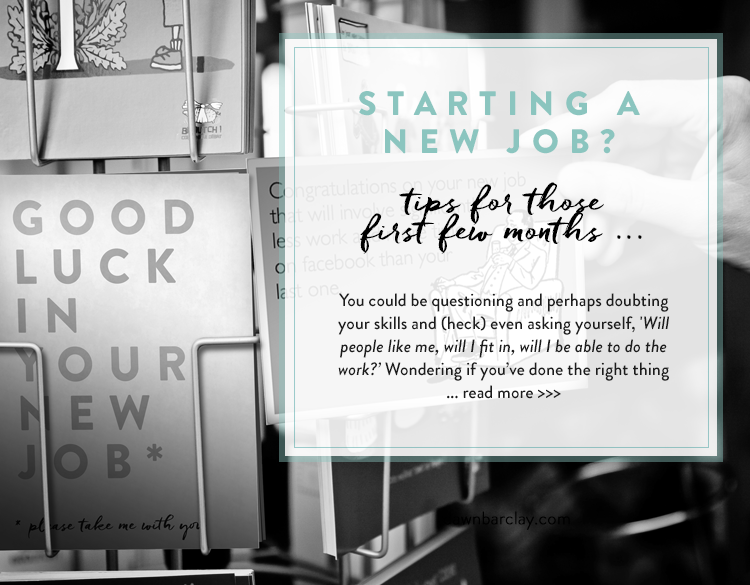
Starting a New Job? Here’s A Few Tips For Those First Few Months

July 25 Dawn

Starting a New Job 2

First up.

Well done you.

Huge congrats.

You’ve landed your new job, obviously the interview was an astounding success: you definitely impressed a few people with your skills, knowledge and gorgeous personality.

You thought the worry was over at the moment when they asked,  ‘Please tell us about yourself’ at the interview but here you are now reading this little ditty because you’ve successfully swapped one fear for another: the interview fear for the fear of actually starting (or maybe you are a few days in and a little anxious because you have no idea if you’ve done the right thing).

You could be questioning and perhaps doubting your skills and (heck) even asking yourself, ‘Will people like me, will I fit in, will I be able to do the work?’

I think it’s known as a teeny-weeny crisis of confidence.

But let’s get a handle on this, assuming that is you’re going to pitch up, yes?

Let’s talk about the inside ‘stuff’, the ‘stuff’ that has you worrying, those little self doubts that just might keep you awake the night before your first day.

What if the job is different to what you imagined?

Imagine you begin and the job is not exactly what you thought it was (from the job description and application form), what do you do?

Ignoring the ones who blatantly have no idea what the hell is required – no matter how hard HR bods and Managers try to accurately state what the role is and is required, they may not work at the face of the role and there could be discrepancies.

What do you do?

a) Leave at lunch time the first morning? (Don’t laugh, people do this).

b) Stay a week and tell yourself that you’ll decide at the weekend?

c) Give it a bit time and go with the flow?

No right answer there, oh, and in my past I have chosen all options, being the wise old soul that I am (cough cough), I would say option ‘c’ is the best solution, giving it time.

There is so much to take in and learn in a new job/role, it’s probably going to feel as if you’re all up in the air, this is perfectly normal. Give yourself time to learn the ropes and give yourself permission to be the newbie.

Will I Fit In?

One of the biggest fears or worries when starting a new job for many can be the question, ‘Will people like me and will I fit in’, my short answer to that is:

Yes. But that’s too vague, huh?

Here’s the thing:

You are technically the newbie and some people will be a lot more welcoming than others (that doesn’t necessarily mean they like or dislike you.)

If you are entering a well established team, remember they are an already formed social group: roles, personalities, reputations, hierarchies (whether spoken or not) are being played, and being the new kid, you entering all that has to be established all over again.

As the new person, you’re not just starting a new job with new tasks and responsibilities you are entering a well established community or social group, almost like a tribe.

And even if they haven’t got them written down, they will have norms and rules they follow.

And no one will probably be able to tell you them.

Why?

Because they may not know them either or that they even exist. Honestly, humans are complicated and messy. Yet, they do exist, they are very real (if this stuff interest you, get your hands on Games People Play by Eric Berne, that’s a link to Amazon), and being the new person it can be uncertain times ahead when you are trying to follow guidelines and rules you don’t know.

And what feelings come with uncertainty? Nervousness, doubt and a lack of security.

Take heart – you will learn these ‘rules’ in time, and yes, you will become part of the community/tribe and you will eventually have your say at writing the new ‘Unspoken Rules Guidebook’ for your workplace. Unless you leave of course.

But say you notice things happening that shouldn’t be, then what?

What if you witness bad practices? People only working when a boss is around? People bitching about others? People covering mistakes?  People deliberately sabotaging the work of another?

If you decide to say something, will you become the outcast?

What then?

What? You want my advice? Okay…

If you witness bad practice (against company policy, guidelines, rules) and it has the potential to harm others, don’t you have a duty here? I’m thinking about care homes, and I’m thinking about bad practice and nobody speaking up. Obviously there are too many unknowns here, seek help. Union? Anonymous helplines? HR?

The rest? The human stuff like back stabbing, slackers, people taking the urine, well, for what is worth, every workplace is different and of course it depends on your values on what you will do or not.

I have worked with people who’s only goal in a team was create to havoc: they ‘waltzed’ into their new role and assumed  (no demanded) respect, authority and trust immediately – they never lasted in the job long, as they haven’t learnt that they are in a ‘new role’ as the new person and like all social groups (they have to earn it first).

And that takes time.  And these same people will hate every new place until they learn this.

Yet it can be accelerated.

How?

Here’s a few tips:

  • You can prepare yourself mentally of how you want to be in your new role…you can think about your attitude, image, and communication skills.  Yet, you obviously can’t prepare others. Show up as the person you said you were on your application, they are in there, right?
  • Be who you are. You were hired on the value you can bring. Don’t forget that. 
  • If you were to start a new role pretending (because you want people to like and love you) you will probably not be able to maintain that behaviour very long. Build your confidence. There’s a wee free confidence course here.
  • Read and understand more on social groups, the way groups form and social roles – you’ll learn about you and it’s a skill for life that one.
  • Time – even a new member of staff starting work (to the existing staff) is change and not a lot of people like change.  It’s not personal.
  • You are fresh remember. Like a new born baby you are not clouded or have any preconceived notions or ideas.  So allow time to get to know everyone, make up your own mind instead of listening to the ‘this is what they are like’ stories from other people.
  • Being the newbie – just because the label is on you, it doesn’t mean to say you have to shut up and go along with everything. Own who you are. And you’re smart, do this in a way of how you would like to be treated.
  • Praise Yourself – this may seem a little wacko, but here’s what I mean – you may be a person that needs to hear you are doing a good job – you need it.  However, you may not get it in your new workplace.  I’m not saying you need all the compliments under the sun, you just need to know if what you are doing is the right thing.  Your new workplace might not be like that…one of unspoken ‘rules’ of the group might be ‘we just get on with it’.  Learn how to compliment yourself – don’t wait for the external world to tell you.
  • If you’re nervous, it will pass.  As you are entering a new situation you may feel uncomfortable, it’s not just a new job its: new people, policies, environment, politics, community – find your flow.  A good team will help with your transition (and yes there may be the odd bugger who does nothing to help you ) each moment will be come easier.
  • Ask for support and supervision.  What if they don’t offer it? Suggest it?.  In fact (it’s probably too late), it’s a very good interview question.

Your goal is to work effectively with other people, some you will find this easy with, others not so well.  As long as the service and role you are carrying out is not affected then fine.

If you make a mistake – admit to it.  Easier than said than done? Back to the staff team, if they are supportive they will accept the error and you can move on from it.

Learn about emotional intelligence and enhanced communication skills. There are some people that could not give a rats tail about how their behaviour effects others (oh and there are some that are the emotional baggage handlers) strike your balance.

Here’s a weird thing,

In my experience working with career changers most people love the first two weeks to a month. Its new, exciting, challenging, relationships and bonds are being formed all over the place.

Then when this time has passed people settle and they become more comfortable, only then can see faults and areas of the new job they are not happy with.

You’re worried about being seen in the best light? See all those other people around you? They too are being on their best behaviour for you.

This is the test.  The first stage is a ‘honeymoon’ period, if there is one tip I could give you (right now) for this time it would be this, the real rewards come when you have all the information. Starting a new job is fantastic but nothing compared to the rewards an effective working team can achieve.

Be you, be calm, listen, be open, be aware all new experiences, take time to learn.

You’ve got this.

And should you ever need it:

Yeah, I know it may be a bit late because the horse has bolted, but if you ever do need help to work out what you should be getting paid for, I’d love to help you figure it out, maybe not today, but remember it’s here if you need it some time down the line.

Do What You Love to Do The ECourse

Love.

Dawn

What One Woman Can Teach Us All About Awareness…

July 21 Dawn

You’ve maybe never heard of Jill Bolte Taylor (until now).  A neuroanatomist she woke up one morning and realised she was having a massive stroke…what’s remarkable (and powerful to hear) is she remembers every moment: she experienced every part of her brain functions slipping away…there is a V-E-R-Y strong (beautiful) message behind her talk, she asks:

‘So who are we? We are the life force power of the universe, with manual dexterity and two cognitive minds. And we have the power to choose, moment by moment, who and how we want to be in the world.‘

Even now, posting it on our blog – we’ve watched it again, and have taken something else from her message.

We hope you enjoy it as much as we did, feel free to leave your thoughts below the video in comments:

  • « Go to Previous Page
  • Page 1
  • Interim pages omitted …
  • Page 50
  • Page 51
  • Page 52
  • Page 53
  • Page 54
  • Interim pages omitted …
  • Page 59
  • Go to Next Page »

Primary Sidebar

Living Moxie Sidebar 1 Hello there you. Once upon a time you were, literally, fully yourself. If you need some help to deploy the most authentic version of you into the world I would love to support you. If this is your first visit click here and let me welcome you properly. Or a great starting place is the resources. Love, Dawn Xo

SELF-PACED WORKSHOPS

#define your core


What do you stand for? What matters to you? To help, download the Core Values Workbook. Click here to find out more.

Recent Posts

  • On ‘Having a Moment’
  • I Hate the Language of Cancer
  • Scratching Your Itches
  • Let’s Talk About ‘Shooting Yourself In the Foot’
  • On Being Enough
  • Career Hijacking (A Story)
  • It Was Just a Thought
  • Try V’s Committed
  • What Are You (Really) Focusing On?
  • You Are Only As Good as Your Last Fuck Up…

Recent Comments

  • Dawn on I Hate the Language of Cancer
  • Living with stage 4 on I Hate the Language of Cancer
  • Dawn on Why Perfectionism and Business Don’t Mix
  • You're Not Perfect! Get Over It and Get Things Done! - Dawn Mentzer, Freelance Marketing Content Writer on Why Perfectionism and Business Don’t Mix
  • Nario on Stop Punishing Your Optimism. Seriously.

For You

  • Blog
  • Updates & Toolkit
  • Confidence Course
  • Define Your Core

Online Programmes & Workshops

the-moxie-project-2 Unfinished Human

Blog Categories

COPYRIGHT © 2017 · LIVING MOXIE · Privacy · Contact · Google+