
• Skip to main content
  • Skip to primary sidebar

Dawn Barclay

Helping you align all that you do with your core values

  • New? Start Here
  • Is This You?
    • You Want to Reclaim Your Courage & Confidence
    • You Want to Align Who You Are With What You ‘Do’ In the World
    • You Need More Moxie for Your Business
    • You Are Looking for Values Training for You or Your Team/Group
  • Work Together
    • Online Workshops & Training (All)
    • Live Events & Training Workshops (All)
    • Upcoming Events (List)
    • ValuesBase© Coaching
  • Blog
  • About
    • Living Moxie Mission & Values
    • Approach & Ethos
    • About Dawn
    • About You, The Moxieologist
    • Kind Words
    • Contact

Moxie Living: Courage and Confidence

All blog post Moxie Living

3 Ways to Deal with Drama Kings and Queens

June 13 Dawn

I know someone who creates a drama out everything that doesn’t go her way.

She thrives on creating ‘a scene’ and doesn’t stop until someone is paying full attention to her, and only her needs.

Maybe you know someone just like her? At work or in your personal life.

I’ve witnessed this person leave others utterly speechless with their emotional explosions, and sometimes it’s not noise and mayhem she creates, she can change the mood of a room, and even a party, with her coldness and silence.

In the past I’ve had to mentally prepare myself before I made a visit to her home: just in case the day I picked a drama was occurring, brewing or had just passed.

Remove them from my life?

No, I love them, it’s only a behaviour I don’t like. They do have some wonderful other qualities.


  • When someone is continually sucking you into their life drama, how can you stay apart from it and still be there for them?
  • How can you care and not allow someone else’s drama to become yours?
  • How can you create a safe relationship where both sides are equal, even if one person doesn’t think the needs of the other are important?
  • Can we?

Here’s my thoughts:

I think we can. But I also know (from the experience above) that we also need to protect and respect ourselves. Because maybe one day the drama will stop. I’m a big girl, I wish they valued another’s needs like they do their own, but for now they don’t.

#1 Stay off the Stage

The drama queens and kings like nothing better than to include people in their performance. You don’t have to take part; you don’t need to step onto that stage with them. Watch from the balcony, as soon as you start paying attention to the drama or the performance, pull yourself back to your seat.

Ask yourself: what can I do to help (not rescue) this person right now? Then do it. That may include walking away.

Ask yourself: what are they getting from this drama? Are they trying to tell me something that they can’t manage right now?

Ask yourself: what do I need right now? And do it.  Nothing states anywhere you have to watch.

#2 Remember It’s Not Your Show

I’ll admit it’s difficult watching and listening to my friend going through the ‘dramas’, there’s a part of me that  thinks ‘why do you do this to yourself?’ I know the answer: they are getting something from it. Play it cool. Don’t fuel their emotions with your own.

Whatever their reasons (which they will have) know it’s not your play, it’s not your story.

Be honest with the review. If you don’t like a behaviour say so, you can do this and still respect the other person. You could try:

“When (insert the behaviour) it makes me feel (insert the feeling), I would prefer it if you would (insert the desired behaviour).

Of course, they don’t have to listen. But if they don’t, that says a lot more.

#3 Bring Down The Curtain – Boundaries

All relationships have boundaries.

And these boundaries will be a different person to person. If you were a coach you would have fixed boundaries: the lines you never cross. Can friendships have the same? I think so.

Another friend of mine is always late. Not once in 16 years, they have never been on time, ever.

We do laugh at the time she traveled the world for a year and missed the last flight back to Edinburgh from London. We have boundaries now, the wait will be no more than half an hour. Give her time to be who she is, and us both a cut off point.

Boundaries keep you safe. So before an interaction with the dramatist:

  1. Protect yourself for each interaction. Know what you will tolerate, and what you won’t. In coaching we agree times, perhaps you agree with the drama queen a ‘free reign’ of time, and that’s it?
  2. Do what’s in your best interest and theirs. If you can’t listen, say so. If you need to create some space, create it.
  3. Tell them what you will and won’t tolerate. And then know what you will do if it’s crossed. And stick to it.

Your Turn

I asked the same question on Facebook: some would ignore, but what about you how do you deal with people who create a drama out of everything? Do you?


 

Monday Morning Pep Talk: When You Hear The Words No

June 11 Dawn

I’ve done it too. I’ve had a dream and then before I even got past, ‘Wow, that’s so possible for me’: barriers were raised, resistance is reared and the dream  is quickly extinguished.

I believe we spend far too much time with voices in our heads that do not belong to us.

Parents, teachers, friends, primary care givers — whoever, when you hear the word ‘No’, or ‘Not possible’, is it your own voice and truth, or does it belong to someone else?

Try this:

For every single ‘not possible’ or ‘I can’t’ or ‘I’ll never be able to’, and so on.

Simply, ask yourself ‘Says who’? Easy.

Examples:

I can’t do that. Says who?

I’m too fat, ugly, thin, unattractive, and so on. Says who?

I’ll never make it. Says who?

I’ll never love like that again. Says who?

I don’t have the confidence. Says who?

I’ll never find a job I love. Says who?

Life is so hard. Says who?

I’ll never get out of debt. Says who?

They would never hire me. Says who?

You have the opportunity here to work out where the real source of the resitance and barriers are, to dive into the shadows of your past to find out who planted the seeds of doubt in your mind of what you are actually capable of.

As soon as you start to see the truth, as it really is (not as you believe it to be), you discover that the barrier and resistance never belonged to you, was it someone else telling you no, because they never thought it was possible for them? Just a thought.


How to Defeat the Bogeymen* Before Breakfast

June 11 Dawn

*All inclusive, please read: Bogeymen. Bogeywomen. Bogeywhatevers.

How to Give Yourself The Heebie-jebbies!!!

I woke up a morning last week with the Bogeymen Gang in my bedroom,  there are six of these hard asses: there’s Fear (the leader), Terror (Fear’s sidekick), Dread and Worry, and the wannabes Guilt and Regret.

I’m pretty sure this doesn’t happen only to me, that there are some of you who wake up with an unexplained heaviness upon you.

You can’t put your finger on it, the reason why (yet) or maybe you do know, are there are events happening that are affecting your mental well-being?

In the past, this bogus-gang have settled themselves down for the day, week, even months.

I’m sure they will be back again.

Experience tells me if I don’t own the game they instigate and defeat them all before breakfast they own my thoughts for the rest of the day or can shadow my every move.

And quite frankly, screw that because most days I have plans.

Their game is simple:

Dread and Worry start the attack. Before I’ve even opened an eye I’m worrying about: family, friends, the pets, work, clients, my life, my purpose, the hole in the bedroom ceiling, on and on it goes, and as you know: thoughts trigger the emotions and feelings.

In no time at all, Anxiety has joined in.  Then, I get concerned over what I should’ve, outta, could’ve done with Guilt and Regret. Fear and Terror just hover around encouraging those four +1 to keep at it.

Not fully conscious, but conscious enough: I call to arms my own homies.

My own sound like an advert for a Superhero movie (cue big booming start of movie voice), “Courage, Strength, Truth, Honesty, Energy and Bugger This, they save the day, one day at a time”

You may be thinking, ‘that’s right Dawn, make it happen, self-fulfilling prophecy and all that’, of course you’re right, yet this is my occasional battle, I think that morning is the last time, only for it to happen a few months later, I’m a work in progress here my lovely.

When fighting this head war, the very brave, one and only Bugger This is always first to step forward and scream, ‘Under attack. Who the let them in so early? Why today? It’s Saturday. We haven’t even had our coffee yet.’

Their cries jolt me fully awake and I leap out of bed with the phrase, ‘No, not today, I’m busy’

Battle Before Breakfast

If the above is you, I don’t have all the answers of how you can change this, here’s a few things that I do, try them if you fancy:

Take action: Maybe just take a few minutes thinking about your answer to: ‘The next time (makes an assumption there will be a next time, that may or may not be true for you), here’s what I will do…insert plan of action…to defeat the Bogeyman Gang (make up a name that doesn’t make sense, changes the program in your head) if they visit before Breakfast.

Ask yourself “How do I feel?” Know and train yourself to become aware of how you feel you when you wake up. Seriously ask yourself ‘How do I feel today?’ You’ll know that answer.

The next part is ‘How do I want to feel by the end of the day?’ Take a few seconds and identify five emotional words, then say them, play them on repeat all day in your head all day.

Listen to music: music changes a mood (can uplift and deplete energy), obviously it’s all a personal choice, and for me I play it loud, play it fast, and play it sing-a-along-y. Tinkly-pinkly water running affairs don’t do it for yours truly.

Exercise: if it’s not being used as a clothes drier, I nip on the treadmill, five minutes is all it takes for me to defeat the gang. Exercise has been proven release natural chemicals to lift negative and heavy moods. We all know that now I’m sure.

Break routines: for me it’s straight in the shower, where usually I take my time waking up, on the gang driven mornings, I break the routines. What routine do you follow that can be mixed up? Changing patterns will require to think about what you are doing, habitual patterns you have less to think about.

Self-care: Sarah at Holistic Hot Sauce asked me about my self-care routine a few weeks ago, and this is one moment when it matters. Having the best coffee in the house, taking time and savouring all I am thankful for, talking to myself like how I would care for a loved one going through a hard time or throwing the leads on the dogs to go for a longer than usual walk.

What About You?

Who are your Bogeymen/women/whatevers? How do you/did you go about beating them before breakfast, if they appear(ed)?


If you enjoyed this post, please share it with your friends.

Why Having 40 Winks May Be The Answer to Your Problem(s)

June 4 Dawn

Has anyone ever said to you while you battle with a problem, ‘just sleep on it’, followed by ‘it’ll look clearer in the morning?’

Have you consciously chosen to put something on the back burner or deliberately incubated a problem for a period of time?

Some research states you shouldn’t sleep on it others swear that getting some shut eye down for a few hours is an excellent idea.

I’m in agreement with the sleep on it people, works for me, but what about you, do you nap out your problems?

Can our problems be solved unconsciously?

I believe we learn best when the learning is unconscious, when we’re engaged in the learning as a complete system.

In learning, have you ever said, ‘where did the time go?’: you were in the flow, unthreatened, no frustration, curious and willing. Where the learning was challenging enough, but not overwhelming. You felt as if you were all there, the time flew by and at the end you just knew you were a lot smarter than when you began?

However with a problem however, have you struggled for days, felt extremely frustrated, ready to throw in the towel?

Did you feel anxious and desperate that you were never going to reach a solution, bored by it, angry even?

Lessons from Children

Have you ever watched a young child solve a toy puzzle?

These youngsters don’t have the linguistics yet to say, ‘oh geez, I’m so darned frustrated, my what a problem!‘, and they never in a teletubby minute give up too soon.

They just focus on the task, totally immersed, curious and stay that way until they solve the problem in front of them, or until they squeal with glee at the end result they have achieved, regardless if it matches the instructions on the box.

That was us once, wearing nappies, covered in droll and excellent problem solvers.

Perfect little sleuths we were: alert, observant and noticing everything around us. Collating all the clues we connected dots and came up with the best solution to the problems we faced.

We knew that in the problem was the solution.

Fecking geniuses all of us, at minus 700 days old!

What happened?

‘Our problems are more serious now!’ cry the grownups.

Yeah, whatever, still doesn’t excuse the fact you used to be remarkable at solving whatever was in your path. We didn’t even need training and management courses to show us how to be creative problem solvers, we knew no methods such as:

  • Brainstorming: coming up with lots of possible solutions and ideas, then finding the most desirable solution.
  • Divide and Conquer: breaking up a problem into lots of little problems that can be solved.
  • Research: finding out information and identifying who had the same problem and applying it to your problem.
  • Root Cause: identifying and taking away what caused the problem.
  • Trial and Error: test, test, test, test until you find the solution eventually.
  • Proof: proving it can’t be solved.

And other common methods such as:

  • Tossing a coin: heads I’ll do this, tails I’ll do that.
  • Denial: do nothing, refuse to admit there is a problem.
  • Opinions: as someone else what they would do and do the opposite!

Incubating and Napping Out Problems

The Latin for incubate is incubare which means lie down on, it’s not denial or ignorance.

Want to give it a go?

In order for incubation to work, you need (according to the big research people) to have completed a few steps first.

Step 1

  • Identify the desired outcome and understand the problem.
  • Decide specifically what you want to happen.
  • Knowing ‘how’ is not your concern, what would the problem look like fixed?
  • What needs changed?
  • What are you ultimately trying to achieve?
  • What you ‘end-result’ thoughts?
  • What is happening at present?
  • Pinpoint when the current ‘problem’ became a problem: what happened, why did it breakdown?

Step 2

  • What do you want to feel when the problem is completely resolved?
  • What will you hear?
  • What will you see?
  • What will you know that you don’t know now (odd question to ask, trust me, you’ll know!)

Step 3

Be a sleuth. Choose your preferred method for information gathering. Gather as much as you can, brainstorm, divide and conquer, pros and cons lists as possible solutions and ideas.

  • Are there better solutions to your problem?
  • What research takes you out your comfort zones?

Step 4

Have a go at solving it. You aren’t looking for the solution, you are merely having a go. Work hard on it, use the skills you have and apply the new skills and learning you gathered at step 3.

  • As we snooze, our brain is busily processing the information we have learned during the day.
  • Sleep makes memories stronger, and it even appears to weed out irrelevant details and background information so that only the important pieces remain.
  • Our brain also works during slumber to find hidden relations among memories and to solve problems we were working on while awake. Robert Stickgold Phd, Jeffrey M Ellenbogen Scientific American

Step 5

Let it go, leave it, sleep on it, incubate it.

Observe the solution when it appears. Huh? Be alert to the solutions.

Further Info:

Psychologist Mihaly Csikszentmihalyi is known for studying happiness and creativity, he’s best known for his work on the notion of ‘Flow’. Here’s his TedTalks video which explains the theory, if you don’t have time watch from 14.00 secs to the end.

Over To You

What do you think? Sleep on it, or not? What’s your biggest problem solving tip. If you watched the video, could your problems be solved in a flow state?

Monday Morning Pep Talk: Your Life Has Meaning

June 4 Dawn

Have you ever said ‘I want my work to be meaningful’?

How about ‘I want to make a difference?’

And finally, ‘I want to be paid for my passions?’

Can we please address this:

Your life can still have meaning if you aren’t getting paid for your passion(s).

What!

Am I doing a 180 on everything on this website?

No.

I’m saying that if you don’t get paid for it, your life is still meaningful.

Ask those that love you for goodness sake.

What if all those questions had nothing to do with your career or what you get paid for?

  • Are all areas of your life filled with personal meaning? If not, what makes you think can find it in your career?
  • Are you making a difference to the people that are already in your life on a daily basis? Friends, family, neighbours, children, the person who serves you in the local shop, people you aren’t that keen on?
  • Are you reserving the energy of passion for a future you? Why not use it now?

I’m not being rude, you aren’t your job, and you aren’t a career, without them you’ll still exist.

What’s your goal?

a) To live a passionate and purposeful life, filled with personal meaning?

b) Or is it to get paid for your passions?

Two things to ponder over:

1. How can you bring the energy of passion into your life today?

2. Where can you make a difference now, regardless if you get paid for it or not?

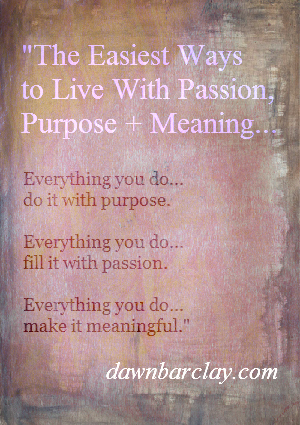
The easiest ways to live with purpose, passion and meaning:

Everything you do, do it with purpose.

Everything you do, fill it with passion.

Everything you do, make it meaningful.

It’s not that simple.

Isn’t it?


How to Change Your Unresourceful State of Mind

May 11 Dawn

They left for work this morning in a mood.

A day of meetings ahead and at 7.35am, they had already decided how their day was going to go.

In short: blech.

Of course being the ever so helpful, extremely annoying, positive peep that I am, I offered some loving support and said, ‘Change your state ‘darling’, otherwise your entire day is going to be ruined’.

With a look that could kill, and the biggest ‘tut’ ever, they left. Note to self: shut up.

I believe we can choose how we want to feel at any moment.

That you and I can change the way we feel – whenever we want to.

The only flip side to this is: there isn’t one.

We’ve already spoken about interrupting negative states before, and I have no doubt you and I have both shared moments, days, weeks when our state of mind has been unresourceful and unproductive.

But it’s our state of mind, and that means we have complete power and control over what goes in and what comes out.

In training, there is a saying there are no unresourceful learners, only unresourceful states. If you’re trainer, you’ll know it’s your duty to deliver an experience that continually leads your trainees into resourceful states (usually high challenge but no threat.)

Same in life.

No event is good or bad, it’s just an event: how we choose to feel about it, that’s up to us.

It’s in that choice which determines if an event is good or bad. A bit like the statement ‘no news is good or bad, it’s how we feel about it that will determine what it is.‘

One Way To Change Your State: Ask Better Questions

Here’s a suggestion.

Oh, wait, only do this exercise when you are in a resourceful state otherwise it’ll bomb.

1. Stop asking habitual negative questions when the shitz is hitting the fan

For example, if things are going haywire and your current habit questions include:

  • Why does this always happen to me?
  • What’s wrong with me?
  • Why can’t I ever get it right?
  • Other people are managing this, I’m not, where am I going wrong all the time?
  • Why am I not like so and so, they manage?
  • And so on.

To the questions you habitually ask yourself, your brain will seek out the answers.

Example: why does this always happen to me?

Your brain will do exactly what you asked of it and return to you a whole string of examples, experiences, thoughts, feelings (from past events) that will confirm to you that the question you asked is correct.

What happens? An already unresourceful state is compounded by more unresourceful memories and feelings from the past, ultimately making growing your current negative state of mind.

2. Start asking ultimate resourceful questions

When in a resourceful state, consider other questions you could ask yourself when ‘events’ unwelcomed and not planned are happening, so that the next time you ‘feel’ your state changing to unresourceful you’re prepared.

You could ask:

  • What is funny about this experience right now?
  • What is this experience teaching me?
  • How can I learn from this?
  • What will I remember about this event in 5 years time?
  • What can I feel instead?
  • What’s the most positive part of this experience?
  • What will I share about this experience next week?
  • How would I like to feel right now? Do I have the ability to make it happen?
  • Know your ultimate question, and use it.

Practice Practice Practice

Yes. this may take a little practice, most of us aren’t taught about ‘states of mind’ nevermind asking resourceful questions.

But you’ve done this before, numerous times, all your doing is taking control of your own state.

When?

Okay, have you ever felt unresourceful and in a negative state then your friends made you laugh?

Have you ever felt ‘under the weather’ and went for a coffee and felt great at the end having hung out with a close friend, or spoke to someone on the phone who uplifted you and changed your frame of mind?

See, there is the flipside. Some people have such powerful states (negative and resourceful) they can sway others with it. Have you ever worked with someone who managed to change the atmosphere of a room because of their state?

Know and own your own state.

How you feel is ultimately up to you, the ‘problem’ or ‘event’ never dictates how you should feel, ever.

What about you?

When you notice your state is unresourceful, what’s your plan?


  • « Go to Previous Page
  • Page 1
  • Interim pages omitted …
  • Page 26
  • Page 27
  • Page 28
  • Page 29
  • Page 30
  • Interim pages omitted …
  • Page 48
  • Go to Next Page »

Primary Sidebar

Living Moxie Sidebar 1 Hello there you. Once upon a time you were, literally, fully yourself. If you need some help to deploy the most authentic version of you into the world I would love to support you. If this is your first visit click here and let me welcome you properly. Or a great starting place is the resources. Love, Dawn Xo

SELF-PACED WORKSHOPS

#define your core


What do you stand for? What matters to you? To help, download the Core Values Workbook. Click here to find out more.

Recent Posts

  • On ‘Having a Moment’
  • I Hate the Language of Cancer
  • Scratching Your Itches
  • Let’s Talk About ‘Shooting Yourself In the Foot’
  • On Being Enough
  • Career Hijacking (A Story)
  • It Was Just a Thought
  • Try V’s Committed
  • What Are You (Really) Focusing On?
  • You Are Only As Good as Your Last Fuck Up…

Recent Comments

  • Dawn on I Hate the Language of Cancer
  • Living with stage 4 on I Hate the Language of Cancer
  • Dawn on Why Perfectionism and Business Don’t Mix
  • You're Not Perfect! Get Over It and Get Things Done! - Dawn Mentzer, Freelance Marketing Content Writer on Why Perfectionism and Business Don’t Mix
  • Nario on Stop Punishing Your Optimism. Seriously.

For You

  • Blog
  • Updates & Toolkit
  • Confidence Course
  • Define Your Core

Online Programmes & Workshops

the-moxie-project-2 Unfinished Human

Blog Categories

COPYRIGHT © 2017 · LIVING MOXIE · Privacy · Contact · Google+